DC Climate Docket Dispatch
Electric bill through the roof? Yard ripped up without notice for a gas pipeline? Or hoping someone in DC is actually doing something to stop climate change?
Good news – you’ve found the one-stop-shop to learn about the part of DC’s government dealing with ALL these issues: the Public Service Commission (PSC). The PSC regulates the District’s utilities – Pepco and Washington Gas – and has the power to make or break our climate commitments. Keep reading CCAN’s Docket Dispatch to learn about the live “dockets” at the Commission and see how our regulators are keeping up with the task.
Ready to take action for lower bills and cleaner energy? Check out CCAN’s campaign to Stop Project Pipes or CCAN Action Fund’s efforts to bring in new leaders and lower bills.
Is the Public Service Comission...
Regulating Gas Pipelines
The PSC has final say over Washington Gas’s spending on its system of methane gas pipelines in DC. As a private utility company, Washington Gas is motivated to do as much work as possible on their system – upgrading it as much as possible so it’s worth more and they can justify raising gas bills to cover the cost of upgrades. It’s the PSC’s job to decide what projects are actually necessary, balancing the need to maintain the safety of the gas system while keeping gas bills reasonable for customers, while ensuring Washington Gas’s activities stay in line with DC’s climate laws – which necessitate moving away from fossil fuels like methane gas.
District SAFE is not a new plan or a plan at all. It is essentially the continuation of Pipes 2, rebranded as District SAFE...To me, this entire exercise has become a waste of time and money with no real benefit to the climate. - Commissioner Beverly, Dissent to Order No. 22367
Docket 1179: Accelerated Pipeline Replacement - also known as Project Pipes or District (un)SAFE
Washington Gas’s ongoing accelerated pipeline replacement project is a massive, $12 billion dollar plan to replace every methane gas pipe in the city – whether it needs it or not. Rather than targeting dangerous and polluting methane leaks, the program focuses on replacement based on pipe material, an imperfect model in which fully functional pipes are replaced all the time – and gas customers foot the bill. In the past ten years, it’s led to no reduction in gas leaks in the District. Yet Washington Gas champions this program, as this method of wholesale pipe replacement is far more profitable to Washington Gas, and more expensive to customers, than modern technologies for repairing leaking pipes.
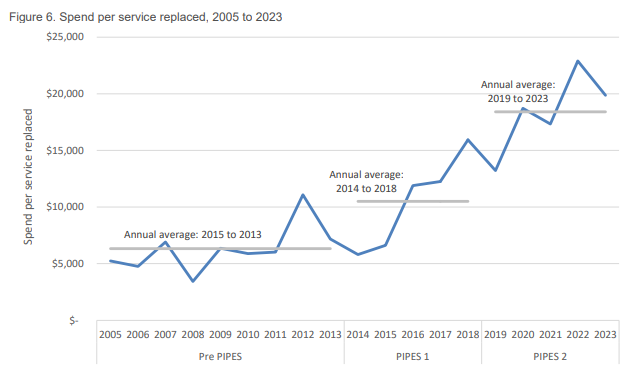
Source: https://ccanactionfund.org/media/source-spend-per-service.pdf[/caption]
In docket 1179, the Public Service Commission is considering District (un)SAFE – Washington Gas’s latest $215 million proposal for the third phase of its accelerated pipeline replacement program. This proposal requests 43% more than any previous phase, which means if approved, gas bills – also known as “rates” – would increase for everyone who pays them.
August 2026 Update
Despite continued opposition, on March 4, 2026 the Public Service Commission approved District (un)SAFE, allowing Washington Gas to spend $150 million ratepayer dollars on accelerated pipeline replacement from 2027 to 2029. But that same week, the DC Court of Appeals remanded (AKA tossed out) a 2024 Commission decision due to a failure to hold a full evidentiary hearing. After petitions to reconsider the District (un)SAFE approval were filed, the Commission re-opened this case in May and decided to host a second, more comprehensive evidentiary hearing with far more issues on the approved list of topics for discussion. You can watch recordings of this hearing here.
In the meantime, the Commission also approved the sixth extension of the ongoing Project Pipes 2, funding the project at $17.76 million for six additional months of work. Past extensions typically granted $25 million for this length of time, so this extension is a slight reduction.
What’s Next?
Now, the Commission will review all this new information and we expect the PSC to issue an updated, final decision on the future of accelerated pipeline replacement in DC this fall.
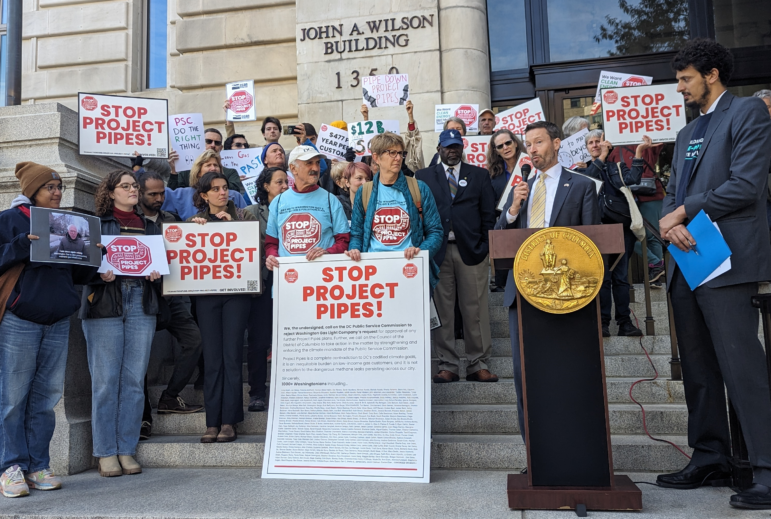
- In December 2025, two dozen activists disrupted the Commission’s hearing on District (un)SAFE – demanding the Commission actually do their job instead of deferring to utilities.
- In November 2025, nearly 50 DC residents rallied outside the Commission demanding they reject District (un)SAFE, including by destroying a massive “pipe tangle” on the sidewalk. A week later, the PSC approved a $25 million extension of Project Pipes 2 through June 2026.
- In September 2025, the Commission required Washington Gas to provide additional testimony on how their project selection model – JANA – works and accepted the DC government’s critical analysis of that model into the docket. This extra testimony is a step in the right direction of applying real scrutiny to Washington Gas’s proposal.
- In the summer of 2025, the DC government finally got access to Washington Gas’s JANA model so they could actually determine how it worked and ask relevant questions. Washington Gas had repeatedly blocked access, despite Commission direction to do the opposite.
- In June 2025, more than 40 D.C. residents turned out to testify and even more organized direct actions at both hearings – a die in and a song. You can read testimony from CCAN here.
- In the spring, ANC 2B and ANC 3B passed resolutions in opposition to District un(SAFE).
- In April 2025, the PSC denied a motion from the Sierra Club and DC government to reconsider their decision to extend Project Pipes 2.
- In March 2025, the PSC approved a $34 million dollar extension of the ongoing phase of Project Pipes until the end of 2025. Commissioner Beverly wrote a scathing dissent of this decision, including this powerful condemnation of District (un)SAFE: “District SAFE is not a new plan or a plan at all. It is essentially the continuation of Pipes 2, rebranded as District SAFE. All it does is present a request for more money to develop project lists in the future just as it would have done under Pipes 2, as though the Commission never said anything about the need for a new approach. Allowing this “plan” to move forward embraces the same failed pipe replacement strategy that the Commission disavowed in Order No. 22003. To me, this entire exercise has become a waste of time and money with no real benefit to the climate.” Read his full dissent here.
- In February 2025, eight DC Councilmembers signed on to a letter urging the PSC to reject Washington Gas’s accelerated pipeline replacement program once and for all.
- In November 2024, 22 organizations called on the PSC to reject District SAFE and end the accelerated pipeline replacement program for good.
- In November 2024, almost 700 DC residents filed comments with the Commission demanding they reject the new District SAFE proposal and instead invest in leak repair
- In October 2024, the PSC granted a 2 month, $8.5 million extension of Project Pipes Phase 2
- In September 2024, Washington Gas refiled for a new phase of Project Pipes, renamed District SAFE, to greenwash their pollution plan
- In June 2024, the PSC denied Washington Gas’s application for Project Pipes Phase 3
- In April 2024, the DC Attorney General urged the PSC to pause Project Pipes
- In February 2024, the PSC said Project Pipes is not “just and reasonable or otherwise in the public interest”
- In February 2024, 11 DC Councilmembers sent a letter to the PSC opposing Project Pipes Phase 3
- In February 2024, though the PSC ultimately approved a 1-year, $50 million extension to Phase 2 of Project Pipes, PSC Commissioner Richard Beverly wrote a strong dissent and cited local advocacy and opposition
- In December 2023, the PSC temporarily put Project Pipes on “pause” after 26 organizations called on the PSC to reject Project Pipes completely
Docket 1178: Investigation into Washington Gas’s Leak Reduction Work
Opened in June 2024, this docket is home to an investigation into leak detection, management, and reporting by Washington Gas. The company is required to maintain their gas system and address gas leaks, and the Commission is investigating how exactly that happens. This is critical to protect our health and safety, as well as to lower emissions in DC. And it’s a serious issue: according to Washington Gas’s own data, between 2024 and 2025 there was a 21% increase in gas leaks in the District. And almost two thirds of those leaks were deemed hazardous.
This docket was opened after years of pressure from intervenors, particularly because Washington Gas’s data on gas leaks and the results of independent studies commissioned by the Department of Energy and Environment yield wildly different results. DOEE’s 2021 study found 3,346 leaks across DC’s gas system. For that same time, Washington Gas reports only 1,298 leaks.
Since 2025, the Commission has been hosting a series of technical conferences to deep dive into leak reduction practices by Washington Gas, explore technologies, and otherwise explore how to lower gas leaks in DC. The DC Office of the People’s Counsel (OPC) would like to take the investigation further, and appoint an independent distribution monitor (IDM). An IDM is a third-party expert that would audit and evaluate Washington Gas’s practices. Basically, instead of Washington Gas telling us what’s going on with gas leaks, a neutral third party would inform the Commission (and the public) and help restore confidence in the data about gas leaks in the District.
Planning the Energy Transition
DC has strong climate laws that commit the District to moving away from fossil fuels and towards clean energy like solar. To meet those goals, we have to stop burning fossil fuels in our buildings. In other words, we have to shift away from methane gas and towards electricity. But how do we actually do that? The PSC is responsible for planning that transition, and has several dockets open to develop that plan.
Docket 1167: Utility Company Climate Planning
Docket 1167 has long been the home of Washington Gas’s and Pepco’s “climate business plans,” long term “plans” that lay out unfulfilled suggestions for programs that could address the utilities’ climate impact. Historically, the Commission has failed to require them to be implemented, even partially, by the utilities. Now, in response to repeated demands from residents, intervenors, and even the DC Council, the PSC started more robust planning efforts where the utilities need to work with District government and other stakeholders to develop proposed plans for Commission approval. Read about progress on electric system AKA integrated distribution system planning in Docket 1182 or our gas planning in Docket 1187.
- In January 2026, several parties filed responses to Pepco’s 200 page, 15-year climate business plan including, the DC Sustainable Energy Utility, Office of the People’s Counsel, DC Government, and Sierra Club. But many of these replies focused more on the Commission’s planning process than Pepco’s proposals. Across the board, most groups were asking the Commission to direct both Pepco and Washington Gas to take concrete actions that bring us closer to DC’s climate commitments, rather than allowing the utilities to lead the way with self-generated plans they are not even obligated to complete.
- In October 2025, Pepco filed its 15-year climate business plan, as requested by the Commission.
- In July 2025, parties responded to the Commission’s request for comments on how our utilities should track and report greenhouse gas emissions. Predictably, the utility companies largely recommended continuing to use existing reporting and plans, while the other intervenors urged the Commission to require more detailed reporting on emissions. Read the full comments from Pepco, Washington Gas, the Office of the People’s Counsel, Sierra Club, and DC government.
- In June 2025, stakeholders filed reply comments to the initial round of comments on if and how the Commission should pursue gas planning, including environmental groups and Washington Gas. D.C. government also filed a whitepaper on how to effectively address gas leaks in the District. The report shows that the percent of D.C. residences using gas in our homes is falling, pipeline repair is consistently more effective at reducing gas leaks than advanced pipeline replacement to address aging pipes, and it would lower bills compared to Project Pipes.
- In April 2025, stakeholders filed initial comments on the feasibility of gas planning, highlighting the need for both short term immediate action and long term planning for the future of thermal energy in the District. Read comments from CCAN and other environmental groups, D.C. government, and Washington Gas.
- In February 2025, the Commission extended the deadline for stakeholder comments on gas planning from February 10 to March 27. This also updates the reply comment deadline to May 12.
- In December 2024, the Public Service Commission requested gas planning comments from stakeholders and another round of climate business plans from the utilities while planning processes are considered. Commissioner Beverly dissented, arguing “it makes no sense” to force Washington Gas to complete a plan without the benefit cost analysis due later this year, and disagrees with delays on the development of this BCA.
Docket 1187: Gas Planning
In spring 2026, the Commission started an integrated natural gas distribution system planning process to plan the long term future of our gas system, especially given net zero emissions laws in DC. This docket was opened in part in response to repeated calls from intervenors and advocates to start a “future of heat” planning process. Future of heat dockets are open in other states around the country, and do more than just gas system planning: they tackle the big questions of how we will transition our heating systems to cleaner options that align with climate commitments. But the DC PSC elected to start a far more limited proceeding, which focused on planning the future of a gas system we believe has no long term future.
August 2026 Update
The working group convened to do gas planning met for the first time in July, and decided how the working group would operate to be ready to publish a final report with joint recommendations. Meeting minutes are available here.
What’s next?
The working group will meet every other week on key planning topics, and then begin drafting a report with recommendations to the Commission.
- In March 2026, the Commission established Docket 1187 to begin integrated natural gas distribution system planning. It specified planning should generally follow the Clean Energy Cohort Roadmap developed by the National Association of Regulatory Utility Commissioners as part of its Task Force on Natural Gas Resource Planning, rather than a broader framework that can plan for a future without gas.
- In April 2025, stakeholders filed initial comments on the feasibility of gas planning, highlighting the need for both short term immediate action and long term planning for the future of thermal energy in the District. Read comments from CCAN and other environmental groups, D.C. government, and Washington Gas.
- In December 2024, the Public Service Commission requested gas planning comments from stakeholders and another round of climate business plans from the utilities while planning processes are considered. Commissioner Beverly dissented, arguing “it makes no sense” to force Washington Gas to complete a plan without the benefit cost analysis due later this year, and disagrees with delays on the development of this BCA.
Docket 1182: Electric Planning
Docket 1182 was opened in November 2024 to collect comments on integrated distribution system planning (IDSP), which focuses on optimizing and modernizing the electric system to meet demands. Given DC’s climate commitments, advocates and officials hope this docket will lead to the development of a framework for Pepco’s planning that factors in the District’s increasing need for electricity due to the transition off of methane gas.
August 2026 Update
This spring, the IDSP working group was supposed to develop a recommendation on the core technical requirements and process of an IDSP framework. But after the allotted five meetings, the working group has yet to even talk about many of the required topics, much less reach agreement.
What’s next?
Now, per Order No. 23133, the working group will have till February next year to develop their recommendations. The order also restructures how the group will collaborate – they’ll work off a draft report developed by the consultants managing the process rather than starting from scratch. But we would have liked to see an even bigger rework of this process, which remains too short and simplified to result in a meaningful plan.
- In February 2026, the IDSP working group had its first of a planned five meetings in the first phase of the process, with a goal to develop the core technical requirements and process of an IDSP framework by August 2026.
- In July 2025, the PSC decided to convene a working group to conduct integrated distribution system planning, after the urging of advocates since the spring.
- In June 2025, Pepco filed their long range plan, as directed by the Commission, outlining expected customer growth and planned capital expenditures.
- In March and April 2025, experts submitted initial comments and reply comments outlining recommendations for a process to conduct integrated distribution system planning.
- In December 2024, Commissioner Beverly published a letter with additional questions for stakeholders to answer, particularly about what data and information the Commission needs to collect from Pepco and how the process could ensure a transparent outcome.
- In November 2024, the PSC asked interested stakeholders to submit comments on IDSP, including responding to a strawman proposal.
Expanding Clean Energy
To complete the transition required by our climate laws, we also need to make sure that electricity is generated by cleaner energy sources – solar panels and wind turbines. The PSC has a key role to play in greening our electricity by making sure Pepco connects local clean energy generation (think rooftop solar) to their grid and by requiring the energy we buy from across the region to be cleaner.
Docket 1017: Deciding where your electricity comes from
The “standard offer service” is the default electricity supply provided by Pepco, and this docket regulates what SOS is available in DC. It’s one of the Commission’s longest running dockets – because we’ve always had to get our power from somewhere!
Critically, this is where the Commission can opt to require Pepco to source clean energy as part of the SOS. This is done by requiring Pepco to provide a certain percent of SOS power through a renewable energy power purchase agreement (PPA). In August 2025, the Commission required Pepco to procure 25% of SOS load (AKA percent of electricity used in DC) from renewable energy PPAs. A year later, Pepco returned with two contracts for wind and solar which will represent 15% of load.
Docket 1050: Connecting Solar
The abundant energy of the sun is DC’s ticket to cleaner, more affordable energy. Since most of DC is urban, rooftop solar is the main way electricity is generated within the District. And the more energy we create, the less we have to buy! But solar panels need to be connected to grids that move the energy generated to where it needs to be used. Most solar in DC is connected to Pepco’s grid, so if a building doesn’t use all the energy it creates it can sell the extra to Pepco for credits. That process of connecting solar and the grid is called interconnection, and is regulated by the PSC in this docket.
Since solar technology is getting better all the time, most jurisdictions update their solar interconnection rules regularly to make sure customers can connect their systems quickly and easily. But DC is long overdue for an overhaul of our rules, and that’s slowing down solar deployment. Pepco has quoted customers almost $100,000 to connect their solar panels, and it can take over two months to get a small system online – nearly twice as long as other states.
In May 2026, Commissioner Beverly submitted a draft for updated regulations that would make solar interconnection faster and easier, but they’ve yet to be voted on by the full Commission.
Lowering Utility Bills
A core function of the PSC is to decide what utility companies’ distribution rates are. These rates determine a major portion of your utility bills, and all of the PSC’s decisions about what utility companies can or cannot spend on impact what the rate is you pay.
The PSC can also lower utility bills by bringing cheaper, cleaner energy onto our grid. Because more supply of energy means lower prices! Read more about how the PSC can do that in the “Expanding Clean Energy” section above.
Docket 1186: Investigation into Energy Affordability
At the moment, this is a catch all docket for the Commission to explore drivers of high utility bills and ways to lower them. But keep in mind that many other dockets – in fact, nearly every other docket – also deals with energy affordability. Docket 1179 deals with a surcharge on our bills, decisions in Docket 1017 influence the price of the actual electricity we buy, and all the planning dockets are dealing with the long term costs of decisions made today by the PSC.
August 2026 Update
Throughout June and July, Commissioner Beverly and Pepco have gone back and forth about the growth of Pepco’s ratebase – the value of a utility’s distribution system (physical property and capital assets). After all the arguing about specific numbers, Beverly’s main argument stands: Pepco’s ratebase is growing far faster since they started getting rate increases approved in multi-year batches than when they applied for one annual increase.
You can think of ratebase as the grandparent to your Pepco bill. Once the ratebase is determined, that justifies the rate, and the rate is a key driver of your electric bill. So why is your Pepco bill so high? Well, Pepco’s ratebase grew by 4.6% on average each year from 2007-2019. From 2019 to 2026? That average was 11.4% each year.
What’s next?
The Commission hasn’t made decisions about how to move forward wit the issues in this Docket. They may start a working group to investigate further. Ideally, work done in this docket on affordability will inform decisions by the Commission in other dockets that impact the cost of our utility bills.
- In June 2026, the Commission held a hearing on energy affordability to hear from stakeholders about how to reduce utility bills for residents. View the transcript here.
- In response to a request by the Office of the People’s Counsel – DC’s ratepayer advocate – the Commission opened this docket in early 2026 to look into rising utility bills for DC residents. The District saw skyrocketing bills in the winter of 2026, due to extreme cold, years of rate increases by the PSC, and the increasing cost of electricity due to the explosion of data centers in the DMV.
[DECIDED] Docket 1180: Washington Gas 2026 Rate Case
In August 2024, Washington Gas submitted an application to raise gas bills or “rates” by 13%, generating $33.9 million of additional revenue for the monopoly utility. The company also asked for an increased rate of return of 7.8% and a return on equity of 10.50%. This return on equity was far higher than the average forecast for returns on an investment – meaning Washington Gas was justifying higher prices for residents like you so they could pay their wealthy shareholders extra.
The proposal also included a weather normalization adjustment, which would have added surcharges or credits to customer’s bills from October through May to stabilize bills based on average weather – allowing Washington Gas to make extra money when winters are warmer than expected – rather than simply having customers pay for the gas they use.
In November 2025, the PSC voted 2-1 in favor of Washington Gas’s gas rate hike. The average gas bill rose by double digits starting January 1, 2026, with half of the cost driven by Project Pipes. On top of that, the Commission failed to get to the bottom of Washington Gas’s use of ratepayer money for lobbying or sort out the entangled mess that is Washington Gas’s affiliate transactions. Basically, we don’t know what exactly we’re paying for… but we do know we’ll be paying more than ever before.
- In November 2025, the PSC voted 2-1 in favor of Washington Gas’s 13% gas rate hike. The average gas bill rose by double digits starting January 1, 2026, with half of the cost driven by Project Pipes. On top of that, the Commission failed to get to the bottom of Washington Gas’s use of ratepayer money for lobbying or sort out the entangled mess that is Washington Gas’s affiliate transactions. Basically, we don’t know what exactly we’re paying for… but we do know we’ll be paying more than ever before. Read Commissioner Beverly’s dissent (pg. 245) for the nitty-gritty details.
- The PSC convened an evidentiary hearing in August 2025 to get answers on key outstanding questions in this docket, including more information on Washington Gas’s lobbying expenses. Sierra Club has been pushing for more complete information from the company for months. DC residents protested at the hearing, demanding the Commission reject the proposed rate hike.
- Washington Gas revealed in July 2025 they included just over $14,000 of litigation expenses and almost $220,000 of costs associated with “government affairs labor costs” in their costs used to justify the proposed rate increase. We need a lot more details to truly understand what this money is being used for, but we know Washington Gas is suing the District for our building efficiency standards and lobbying at the Wilson Building against legislation to promote clean energy.
- In May 2025, Washington Gas filed the final rejoinder testimony, and intervenors all filed lists of material issues of fact.
- In April 2025, nearly 70 D.C. residents testified at community hearings against the rate hike.
- In January 2025, four intervenors filed direct testimony on Washington Gas’s proposed rate hike, and all has significant objections to Washington Gas’s proposal.
- In August 2024, Washington Gas filed an application for a rate hike. This application comes just seven months after the company’s last rate hike went into effect.
GLOSSARY:
Abstention: Voting option for Commissioner; means they are sitting out and not voting
Comment: Written thoughts on a matter at the PC, formally filed into a docket. Can be made by members of the public or experts at any time, and are sometimes requested by the Commission so they can collect feedback
Concurrance: Voting option for Commissioner; means they agree with the majority vote but have additional comments and/or different reasoning
Dissent: Voting option for Commissioner; means they disagree with the majority vote
Distribution System: Infrastructure that gets gas or electricity around DC and into buildings
Docket: Like a folder, holds all information and records on a given topic; created and managed by the Commission; Otherwise known as a Formal Case
Formal Case: Like a folder, holds all information and records on a given topic; created and managed by the Commission; Otherwise known as a docket
Generation System: Solar panels, wind turbines, gas plants, and other power plants that create the actual energy we use
Intervenor: Refers to an organization, person, or government office working on a docket or participating in a working group; Otherwise known as a party
Methane Gas: Colloquially known as “natural gas,” this is the gas made almost entirely of methane (a fossil fuel) used for heating and cooking
Party: As in “party to a case,” refers to an organization, person, or government office working on a docket or participating in a working group; Otherwise known as an intervenor
Petition: A request by a party/intervenor for the Commission to take a particular action
Rate: How much gas or electricity costs
Rate Case: Formal case in which the PSC responds to a petition by a utility to change the rate it charges customers
Ratebase: The value of a utility’s distribution system (physical property and capital assets), which is used to justify its rate
Return on Equity: The amount of shareholder profit that investor-owned utilities are allowed to collect from customer bills
Stakeholders: A person with an interest or concern in something
Surcharge: An additional charge added to customer utility bills for a particular program or purpose
Transmission System: The infrastructure that connects where energy is generated to where it needs to be distributed; typically very large pipelines (ex. Mountain Valley Pipeline, Keystone Pipeline, Dakota Access Pipeline) or wires
Working group: A group of stakeholders (volunteer or required to participate by the PSC) that work on a dedicated issue in regular meetings (typically not more than monthly), sometimes facilitated by a consultant hired by the PSC, to develop a specific proposal for PSC or utility action